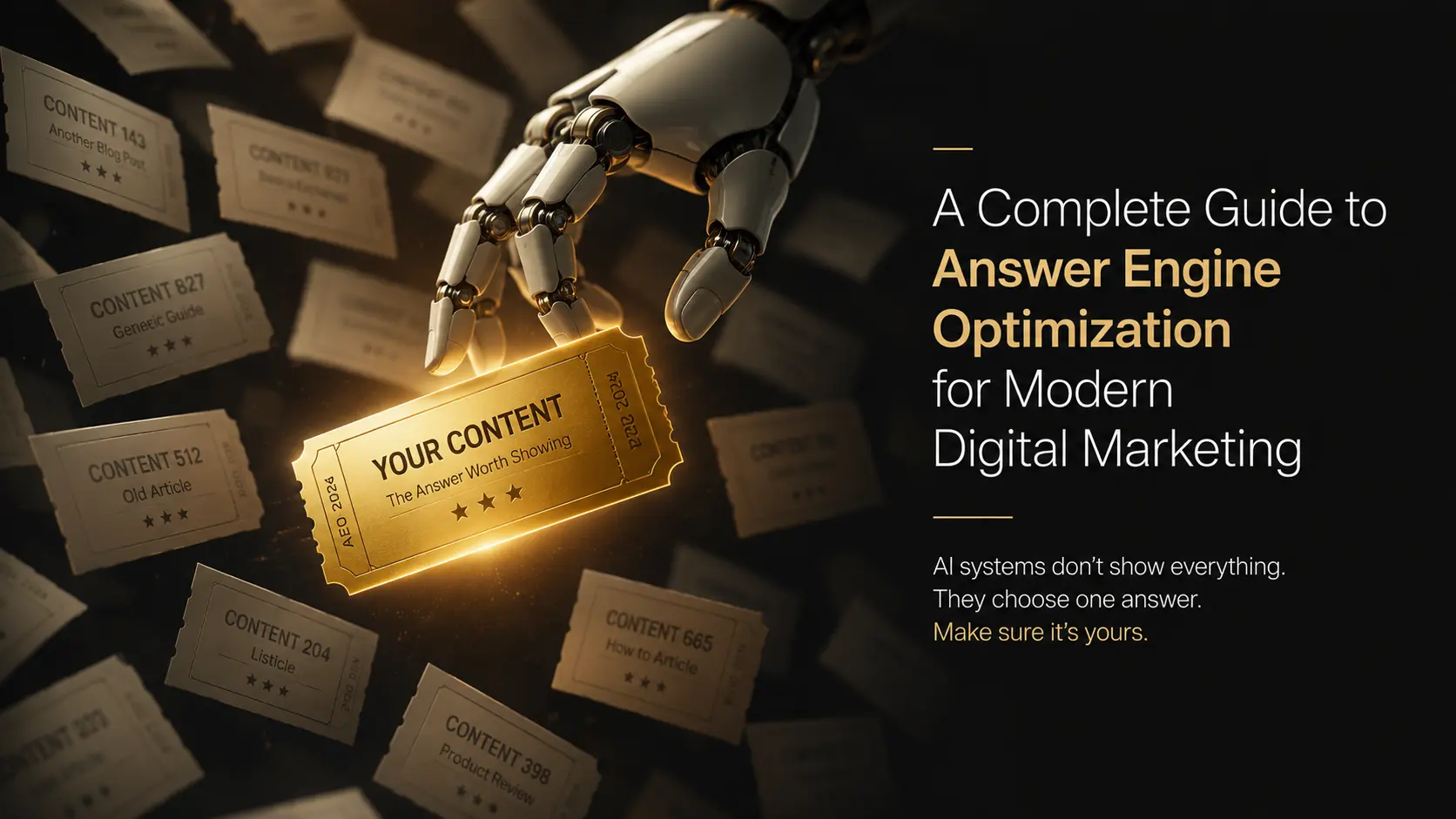
Search results no longer look like search results. AI Overviews, chatbots, and voice assistants now answer questions directly, often skipping the click to your site. Answer engine optimization is how brands earn a place inside those answers instead of getting left out. This guide breaks down what AEO means and how to structure content that AI systems choose to feature.
What Is AEO (Answer Engine Optimization)?
Answer engine optimization, or AEO, is the practice of structuring content so AI-driven answer engines can find it, understand it, and feature it directly in their responses. Unlike traditional SEO, which optimizes for a ranked list of blue links, AEO optimizes for a single, synthesized answer. It targets platforms like Google AI Overviews, ChatGPT, Perplexity, and voice assistants. Some marketers in UK and international markets write it as answer engine optimisation, though the strategy stays identical. AEO builds on SEO fundamentals but prioritizes clarity and directness over keyword volume alone.
The Shift from Search Engines to Answer Engines
For two decades, search engines rewarded brands that ranked on page one. Users clicked, compared, and chose. That model is breaking down. Google’s Search Generative Experience (SGE) and its successor, AI Overviews, now answer many queries before a user scrolls to any link. Zero-click searches are becoming the norm, not the exception. Voice assistants compress this further, reading out a single answer with no visual list to browse at all. This shift changes what “ranking” even means. A brand can lose visibility on the results page yet still lose the customer relationship, because the answer engine already gave the user what they needed. Marketers now compete to be the source an AI model trusts and cites, not just the page a human clicks through to. That requires a strategy built around structure, authority, and precision rather than keyword volume or backlink count alone.
Core Principles of Answer Engine Optimization
Structuring Content for AI Overviews
AI Overviews and answer engines scan content for extractable chunks, not full narratives. Content structured with clear headings, short paragraphs, and direct answers near the top of each section gets pulled more often. Bullet points, numbered steps, and definition-style openings help models isolate the exact sentence that answers a query. Burying the answer under a long introduction reduces the odds of being featured at all. Writers should treat every H2 and H3 as its own mini-answer, complete enough to stand alone if lifted verbatim into an AI response.
E-E-A-T (Experience, Expertise, Authoritativeness, Trustworthiness)
Answer engines lean heavily on E-E-A-T signals: Experience, Expertise, Authoritativeness, and Trustworthiness. Models favor sources that demonstrate real, first-hand experience and verifiable credentials over generic, unattributed claims. Author bylines, case studies, original data, and clear sourcing all strengthen these signals. Brands that publish thin, recycled content without evidence of expertise are less likely to be cited, even if their keyword targeting is technically sound. Building topical authority over time, through consistent, well-sourced publishing, matters more for AEO than it did for traditional keyword-based SEO.
Conversational Queries and Natural Language
Answer engines are built to handle conversational, natural-language queries rather than fragmented keyword strings. People ask AI tools full questions, the way they’d ask a colleague. Content that mirrors this phrasing, using question-based headings and plain, direct language, aligns better with how models parse intent. Writing “How does answer engine optimization work?” as a heading performs better than a keyword-stuffed fragment. This favors content that sounds human and specific over content optimized purely for search volume alone.
How to Optimize Your Content for AI Answer Engines
Targeting Long-Tail Question Keywords
Long-tail, question-based keywords are the backbone of AEO. Instead of chasing broad, high-volume terms, target the exact questions your audience types or speaks into AI tools, such as “what is AEO” or “aeo what is” and its full-form variants. These phrases map directly to how answer engines process conversational queries, since AI models are trained to match intent, not exact strings. Tools like AlsoAsked and Google’s own “People Also Ask” panel surface real question data worth targeting in your content calendar.
Using Schema Markup and Structured Data
Structured data helps answer engines understand context they can’t infer from plain text alone. FAQPage, HowTo, and Article schema make it easier for AI crawlers to identify question-answer pairs and pull them accurately into a generated response. Schema markup won’t guarantee inclusion in AI Overviews, but it removes ambiguity for the machines parsing your page, which improves your odds meaningfully over time.
Creating Direct, Concise Answers
Every section should open with a direct answer before adding nuance or context. Save caveats and examples for the sentences that follow, not the ones that lead. This answer-first structure mirrors how AI Overviews extract content, and it respects readers who want the point immediately. Understanding AI Overviews and their broader SEO impact clarifies exactly what these systems reward when choosing a passage to surface.
Measuring Success in AEO
Traditional SEO metrics like keyword rankings don’t fully capture AEO performance. Brands need to track new signals: appearance in AI Overviews, citations in ChatGPT or Perplexity responses, voice search visibility, and referral traffic from AI-driven platforms. Tools are emerging to monitor “share of answer” the way rank trackers monitor share of search. Watching branded query volume and direct traffic also helps, since AI answers often build awareness before a user ever clicks through to a site. Staying current with the importance of search trends data ensures marketing teams catch shifts in query behavior before competitors do, and adjust content plans accordingly and quickly. Measurement in AEO is still maturing, but the direction is already clear: visibility inside the answer now matters as much as visibility on the page itself, if not more.
Conclusion
Answer engine optimization isn’t replacing SEO, it’s extending it into a world where AI delivers the first answer a user sees. Brands that structure content clearly, back it with real expertise, and answer questions directly will earn a place inside AI Overviews, chatbots, and voice results. The brands that ignore this shift risk losing visibility even while technically ranking well on paper. AEO is now a core skill for anyone building a modern digital marketing career, not an optional add-on to existing SEO work going forward.
Working with an experienced SEO agency in Mumbai can help brands translate these principles into a structured, measurable AEO strategy.
Frequently Asked Questions
What is the full form of AEO in digital marketing?
AEO stands for Answer Engine Optimization, the practice of optimizing content so AI platforms like Google AI Overviews, ChatGPT, and Perplexity can find and feature it directly in generated answers.
How does Answer Engine Optimization differ from traditional keyword targeting?
Traditional keyword targeting focuses on ranking for search terms across a results page. AEO focuses on becoming the source an AI model cites for a single answer, prioritizing clarity over keyword density.
Which search platforms rely on AEO strategies?
Google AI Overviews, ChatGPT, Perplexity, Microsoft Copilot, and voice assistants like Siri and Alexa rely on answer engine principles, pulling from structured content to generate responses.
How do AI Overviews decide which content to feature?
AI Overviews prioritize content with clear structure, direct answers near the top of each section, strong E-E-A-T signals, and validated schema markup that removes ambiguity.
Is schema markup mandatory for Answer Engine Optimization?
Schema markup isn’t mandatory, but it improves accurate extraction. FAQPage, HowTo, and Article schema give answer engines explicit context, making it easier to pull well-formed answers.
Can small businesses compete in AEO against large brands?
Yes. AEO rewards clarity and genuine expertise over domain authority or ad spend. Small businesses that answer questions precisely can be featured just as often as larger competitors.
Ready to make sure your brand gets the answer, not just the ranking? Let’s Connect.