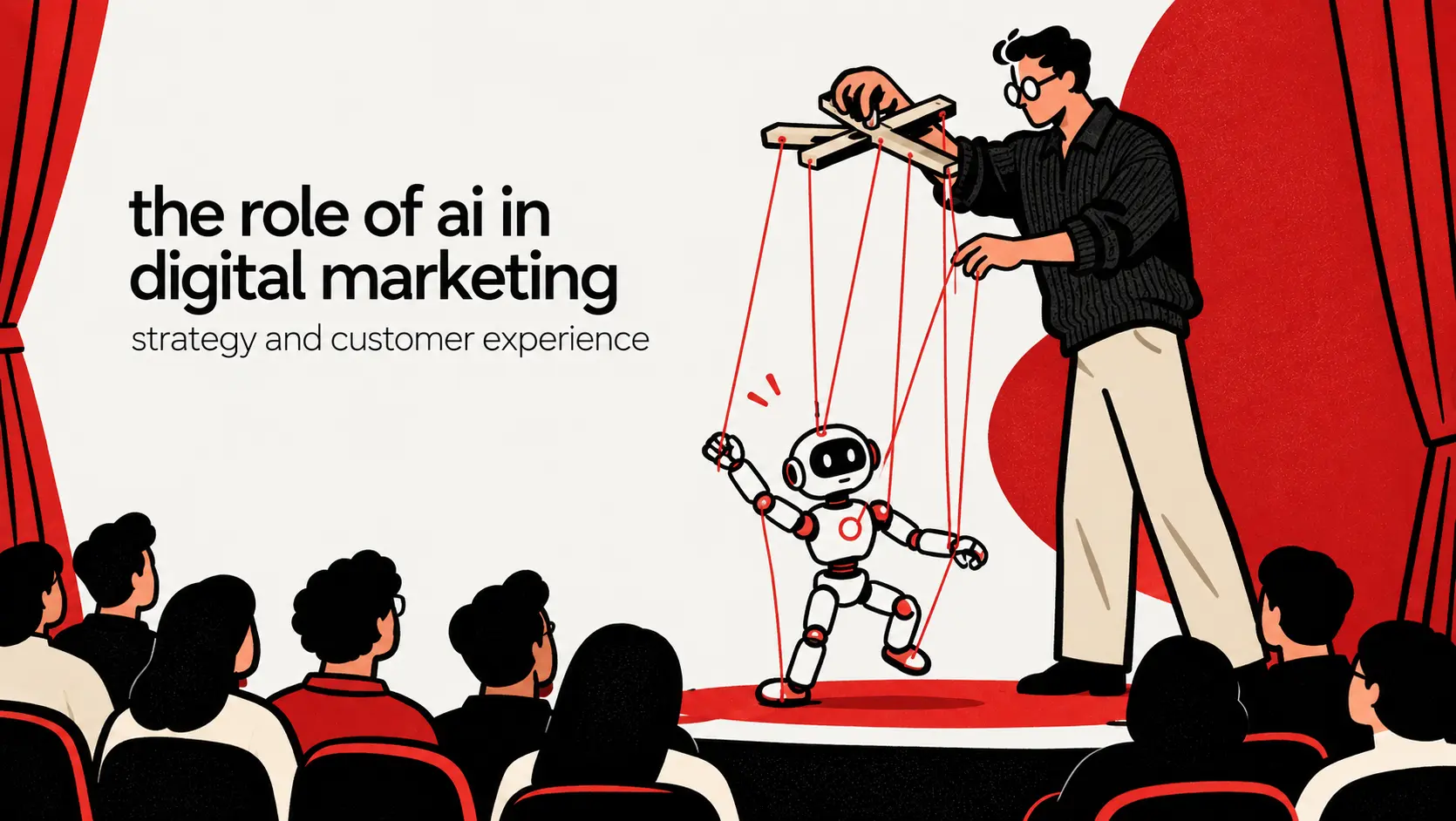
Artificial intelligence is reshaping how businesses understand customers, plan campaigns, create content, and improve digital experiences. AI in digital marketing enables brands to process large volumes of data, identify behavioural patterns, automate repetitive activities, and personalise interactions at scale. When implemented strategically, AI can strengthen decision-making while helping marketers deliver more relevant and consistent customer experiences.
Understanding the Growing Role of AI in Digital Marketing
The role of AI in digital marketing has expanded as businesses generate more customer data across websites, search engines, social platforms, advertising channels, and CRM systems. AI technologies help marketers analyse this information faster and convert it into actionable insights.
The relationship between AI and digital marketing now extends beyond simple automation. Businesses are increasingly using AI for audience segmentation, predictive modelling, content personalisation, campaign optimisation, customer support, and media planning, allowing marketing teams to make more informed decisions throughout the customer journey.
How Digital Marketing with AI Transforms Business Strategy
Effective digital marketing with AI is not simply about adopting new tools. It involves integrating artificial intelligence into broader marketing objectives so technology supports audience understanding, customer acquisition, conversion, and retention.
Businesses can use AI to recognise patterns that may be difficult to identify through manual analysis alone. These insights can influence campaign planning, channel selection, messaging, budget allocation, and customer engagement strategies.
For organisations monitoring evolving performance marketing trends for Indian brands, AI can provide a valuable layer of data analysis and automation that supports faster experimentation and more responsive campaign management.
Predictive Analytics and Audience Insights
Predictive analytics uses historical and real-time information to identify patterns and estimate likely customer behaviour. Marketers can use these models to understand which audiences may be more likely to engage, convert, purchase again, or respond to specific offers.
This approach can make AI-based digital marketing more focused by helping businesses prioritise high-potential customer segments instead of applying identical messaging to every audience.
AI can also support market research by analysing search behaviour, campaign interactions, customer feedback, and purchasing patterns. Combined with human interpretation, these insights can help marketers identify emerging needs and refine audience strategies.
The growing influence of AI overviews in digital marketing also highlights how artificial intelligence is changing both search behaviour and the way brands approach visibility, content, and information discovery.
Personalization in Digital Marketing Using AI
Personalisation is one of the most practical applications of digital marketing using AI. Rather than presenting every customer with the same experience, businesses can adapt recommendations, messaging, offers, and website experiences using behavioural and contextual information.
For example, AI systems can evaluate browsing history, previous purchases, engagement levels, location signals, and customer preferences to determine which products or content may be most relevant.
Personalisation can also contribute to conversion rate optimization by helping businesses reduce friction and present users with more appropriate messages or calls to action at different stages of the customer journey.
However, effective personalisation should still consider data quality, privacy expectations, brand guidelines, and human oversight.
Campaign Automation and Optimization
Marketing platforms increasingly use machine learning to automate bidding, targeting, creative selection, scheduling, and budget distribution. This allows marketers to manage complex campaigns while responding more quickly to performance changes.
Using AI in digital marketing can also help teams identify underperforming advertisements, detect audience fatigue, compare creative variations, and adjust campaign parameters based on predefined objectives.
AI is particularly relevant to new age media buying, where advertising decisions can involve large datasets, multiple channels, real-time auctions, and continuously changing audience behaviour.
Businesses should still establish clear KPIs and review automated recommendations rather than assuming that every algorithmic adjustment automatically supports long-term business objectives.
Enhancing Customer Experience Through AI-Based Digital Marketing
Customer experience is another important area where AI-based digital marketing can create measurable value. Customers increasingly interact with businesses across websites, applications, email, search, social platforms, and customer support channels.
AI can help connect information across these touchpoints and enable brands to respond with greater speed and relevance.
Successful implementation requires more than automation. Businesses should combine AI capabilities with strong customer journey design, accessible interfaces, clear communication, and effective service processes. Working with a specialist UI UX design Agency in Bangalore can also help organisations ensure that technology-led personalisation supports an intuitive and user-friendly digital experience.
Conversational AI and Customer Support Integration
AI-powered chatbots and virtual assistants can provide immediate responses to common customer questions, guide visitors towards relevant information, qualify leads, and support basic service requests.
When integrated with CRM and support platforms, conversational systems may also use existing customer information to provide more contextual responses.
Businesses implementing AI-driven digital marketing can use conversational AI across different stages of the customer journey, including product discovery, lead generation, onboarding, order tracking, and post-purchase assistance.
Human support remains important for complex, sensitive, or unusual situations. A well-designed system therefore uses automation to handle appropriate routine interactions while providing a clear route to human assistance when necessary.
Automated Dynamic Content Delivery
Artificial intelligence can help businesses determine which content, product recommendations, promotions, or messages to display based on customer signals.
Dynamic content can appear in websites, applications, emails, advertisements, and other digital touchpoints. For example, returning visitors may see different recommendations from first-time visitors based on previous interactions.
This capability makes digital marketing with AI more responsive because marketing experiences can adapt without requiring teams to manually create separate journeys for every individual customer.
AI can also support paid advertising by matching creative assets with relevant audience groups. When combined with expertise from the best ppc company in Bangalore, businesses can use automation alongside strategic campaign management, creative testing, and performance analysis.
Key Benefits of Adopting AI-Driven Digital Marketing Solutions
Adopting AI-driven digital marketing solutions can help businesses improve efficiency, analyse information more quickly, personalise customer experiences, and optimise campaigns at greater scale.
AI may also help marketing teams identify audience patterns, automate repetitive processes, accelerate experimentation, and make better use of first-party customer data.
The strongest results generally come when AI supports clearly defined marketing objectives rather than functioning as a standalone initiative. Businesses should combine technology with reliable data, experienced teams, strong creative thinking, customer understanding, and continuous measurement to build sustainable marketing capabilities.
Conclusion
The growing connection between AI and digital marketing is changing how brands plan campaigns and engage customers. From predictive analytics and personalisation to automated media buying and customer support, AI can make marketing more responsive and efficient. Businesses that combine AI capabilities with human strategy, creativity, and oversight can build stronger, more adaptable digital experiences.
Frequently Asked Questions
What is the role of AI in digital marketing?
The role of AI in digital marketing is to help businesses analyse data, recognise customer patterns, automate marketing activities, personalise experiences, and optimise campaigns. AI can support functions including audience segmentation, advertising, content recommendations, predictive analytics, lead scoring, customer support, and performance measurement.
How can companies start using AI in digital marketing?
Companies can begin using AI in digital marketing by identifying specific marketing problems that AI could help solve. They might start with automated campaign optimisation, customer segmentation, content assistance, predictive analytics, or chatbots. Businesses should establish measurable goals, assess data quality, select appropriate technology, test on a limited scale, and review results before expanding adoption.
What are the main benefits of AI-driven digital marketing?
The main benefits of AI-driven digital marketing include faster data analysis, increased automation, improved audience targeting, greater personalisation, quicker optimisation, and more efficient campaign management. AI can also help businesses identify patterns across large datasets that marketers may find difficult to analyse manually.
How does AI improve customer experience across touchpoints?
AI can improve customer experience by helping brands deliver relevant content, recommendations, support, and communication across websites, applications, email, advertising, and service channels. Digital marketing using AI can also help businesses respond to behavioural signals in real time, creating experiences that are more contextual and consistent throughout the customer journey.
Is digital marketing with AI suitable for small and medium businesses?
Yes. Digital marketing with AI can be useful for small and medium businesses because many advertising, analytics, CRM, email, and content platforms already include AI-powered functionality. Smaller businesses can begin with targeted applications that solve specific problems rather than investing in complex AI infrastructure, allowing adoption to expand as their marketing requirements and data capabilities grow.